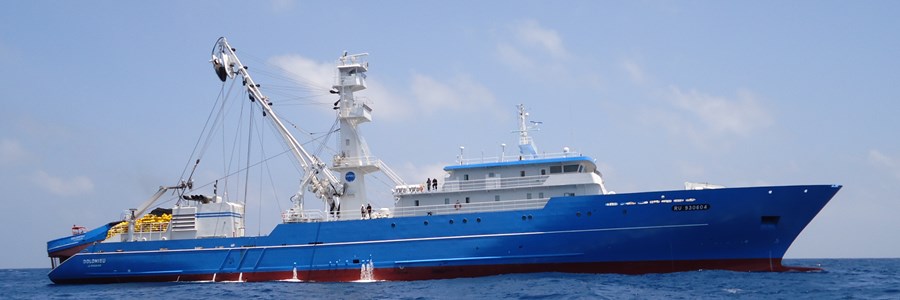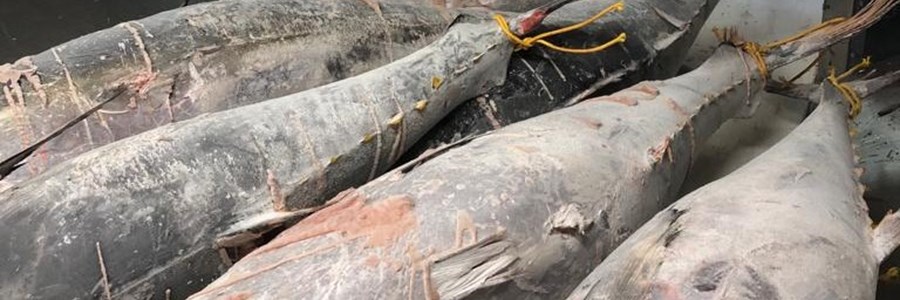
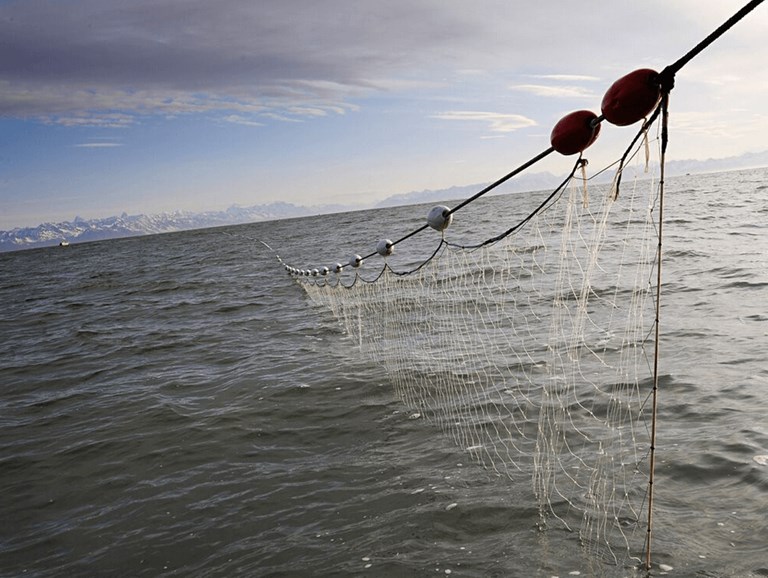
Large pelagic drift nets, are nets of over 2,5-kilometer-long and many meters deep, that are left drifting in the ocean to catch any living creature that happens to swim by. The international community and the EU have long adopted a global moratorium on all large-scale pelagic drift-nets fishing in the world’s oceans and seas, especially to catch migratory species such as tuna. However, their use is still overspread, especially in the Indian Ocean, responsible nowadays for around 20% of the total catches of yellowfin tuna and high levels of by-catch of threatened and protected species such as sharks, marine mammals and turtles. The tuna fishing industry represented by Europêche calls on the EU and IOTC parties to stop turning a blind eye on this long-lasting problem and make a stand against these illegal practices during the next IOTC meeting.
As an analogy, let us imagine a driver that systematically ignores a red light, every day, for around thirty years. This traffic light was set by an authority to address an issue at a crossroads, including a video-camera to monitor compliance. While the driver is identified, no ticket is handed out. This authority believes that penalties do not help to bring change and simply calls the driver from time to time, to tap on the shoulder and encourage to do better next time. To no avail. At the same time, hundreds of cars crash to avoid hitting the non-compliant driver. To add injury to insult, the reckless driver is rewarded with a car insurance fee discount every year. One would think such a situation cannot happen in reality.
Nonetheless in the world of fishing, the United Nations General Assembly (UNGA) adopted a Resolution in 1991 calling upon all members of the international community to implement before 31 December 1992 a global moratorium on all large-scale pelagic drift net fishing on the world’s oceans and seas.[1] Despite the UN ban, in 2012, the Indian Ocean Tuna Commission (IOTC) expressed concern that these gears were still widely used in both high seas and coastal waters of the Indian Ocean. As a consequence, the IOTC adopted a Resolution[2] that year, reinforced by another in 2017[3], setting the prohibition to use large-scale driftnets in the whole IOTC Area.
In other words, long time ago the UN and the IOTC (a.k.a. the authorities) adopted a rule, setting a red light on the use of large pelagic drift nets. Regrettably, according to Europêche, in the Indian Ocean many of the countries that were supposed to stop by the red light, as our driver, never did, and even increased the use of drift nets or its size to over 30 km in length and more than 20 m in depth[4]. This happened because these countries were never penalized, as IOTC Member countries, and international authorities, preferred to use the tap on the shoulder approach rather than sanctioning such behavior. Furthermore, the IOTC rewarded some drift net fisheries with catch limits of yellowfin tuna since 2017 (discount on the car insurance fee), despite the existing gear ban and the fact those fisheries are poorly monitored, not even complying with the minimal IOTC requirements for observer programs or sampling in port.
Javier Garat, President of Europêche, declared: “One would expect things to go differently in 2021. Well, this is not the case. The IOTC will hold a Special Session between 7 and 12 March, with the focus put on the rebuilding of the stock of yellowfin tuna. The EU and Maldives have formally tabled proposals to the meeting. Despite the European Commission’s zero-tolerance approach towards IUU fishing, those proposals are still rewarding large pelagic drift net fisheries with catches of yellowfin tuna and solely tapping them on the shoulder through recommendations to improve gear configuration. Hence, after almost thirty years of non-compliance with international regulations, our reckless driver will continue business as usual, whereas all other fisheries are penalized with higher cuts, crashing their cars to compensate for that.” Mr Garat concluded: “We are talking about a gear banned by the EU since 2002 for migratory fisheries such as albacore, Bluefin tuna or swordfish. The EU must ensure coherence between the internal and external dimension of the CFP”.
Tuna-RFMOs have been criticized for not being able to enforce what they adopt. Unfortunately, in this case, Europêche must agree with that statement. The European fishing sector strongly believes it is high time for IOTC and other tuna-RFMOs to make drift net fisheries accountable for their actions, rather than rewarding them after thirty years of trespassing red lights. The next IOTC Special Session might represent a good opportunity for this body to start using the stick rather than the carrot. The EU should also consider to take market measures against IOTC countries not compliant with international rules. Otherwise, it may be too late for the yellowfin tuna stock to recover and for the protection of sensitive species, despite the efforts and cuts imposed on the European tuna fishing fleet.
[1] Resolution A/RES/46/215, Large-scale pelagic drift-net fishing and its impact on the living marine resources of the world’s oceans and seas
[2] Resolution 12/12
[3] Resolution 17/07
[4] Cetacean bycatch in Indian Ocean tuna gillnet fisheries (page 41)
Press contacts:
Daniel Voces, Managing Director of Europêche: +32.2.230.48.48 europeche@europeche.org